
A practical guide for stores that sell in pesos, in dollars, or both.
Figures below are in Colombian pesos (COP). USD approximations use a rate of roughly 3,200 COP per dollar as of mid-2026 — check current rates for an exact conversion.
Almost every e-commerce project that comes into the studio arrives with the same poorly framed question about payment gateways in Colombia: “which one is the cheapest?” The short answer is that none of them is, in any absolute sense. The useful answer requires looking at three variables almost nobody cross-references: where your buyers come from, how they pay, and what platform your store runs on.
This guide organizes those variables into a decision framework.
Credit card fees in Colombia sit in a narrow range, roughly 2.8% to 3.5% plus a fixed fee per transaction plus VAT. Between the priciest and the cheapest gateway in that range, the real difference is around half a percentage point.
Meanwhile, there are three costs that actually move the needle and rarely make it into the comparison:
Shopify Payments doesn't operate in Colombia. That means every Colombian store on Shopify has to use a third-party gateway, and Shopify charges an extra fee for that integration on top of whatever the gateway charges.
The surcharge depends on your plan:
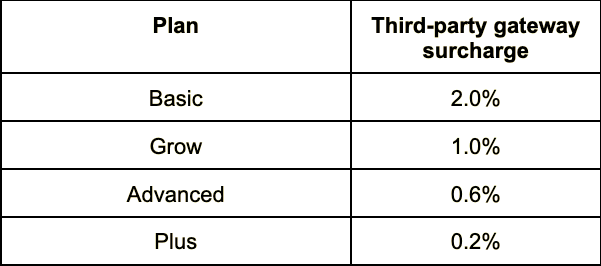
Most Colombian stores on Shopify are on the Grow plan, with a 1% surcharge. If your gateway charges 3% plus VAT, your real cost per card transaction is closer to 4.5%, not 3%. On $20,000,000 pesos (~US$6,250) billed per month in card sales, that extra 1% is $200,000 pesos (~US$62) walking out the door without showing up on any quote.
The practical consequence: in Colombia, figuring out which Shopify plan makes sense doesn't depend on how many products you have. It depends on your sales volume. There's a crossover point where upgrading to Advanced or Plus is cheaper than staying on Grow and paying that 1%. It's worth calculating before you sign up, not six months later.
On platforms where you control the hosting, like WooCommerce, this surcharge doesn't exist. That single factor can offset the higher maintenance cost of running your own stack, depending on volume.
In Colombia, a large share of online purchases are paid via PSE bank transfer, not card. And PSE costs considerably less: roughly 1.3% to 2%, versus 3% for cards.
This has a design implication, not just a financial one. If your checkout presents PSE with the same visual weight as the card option, or worse, buried behind “other payment methods,” you're paying for friction you created yourself. Ordering payment methods at checkout is a margin decision disguised as an interface decision.
The corollary: when comparing gateways, don't look at the card fee. Look at the blended fee weighted by your actual payment mix. If 60% of your sales come through PSE, the gateway with the better PSE rate is the right call even if its card rate is worse.
To make this concrete: here's how it looks for a store with $20,000,000 pesos (~US$6,250) in monthly revenue, a $50,000 peso (~US$16) average ticket, Shopify's Grow plan (1% surcharge), and a 65% card / 35% PSE split — a fairly typical mix in Colombia:
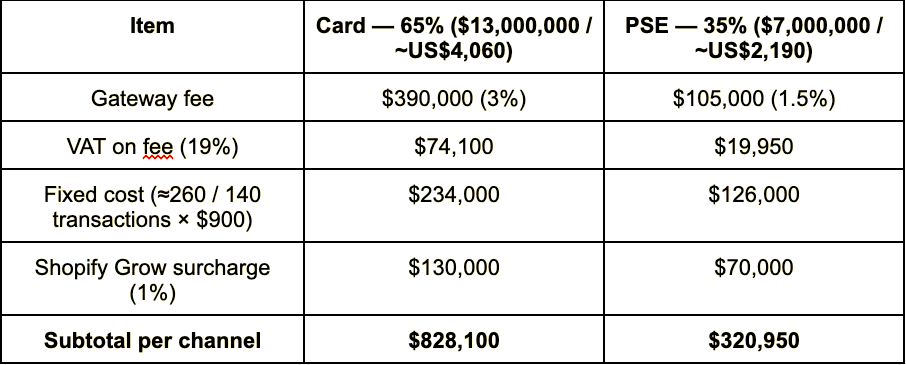
Total cost comes to $1,149,050 pesos (~US$360) — an effective 5.75% of total revenue, not the 3% shown on any gateway's homepage. That gap is exactly what gets lost when you compare only the nominal percentage.
Figures are approximate as of 2026, subject to plan, volume, and negotiation. Always confirm the current rate with the provider before deciding.
When the product is digital — a font, a course, a plugin — the international buyer shows up on their own. And that's where the problems start: Colombian gateways are optimized for pesos and local payment methods, not for a designer in Berlin paying with a Visa card.
The possible routes, and their trade-offs:
There's no single correct answer among the four. There's a correct answer for your current split between local and international sales, and that split changes. Locking in a permanent structure before you have sales data is optimizing blind.
An order that works:
The best gateway is the one you can actually manage. We've seen stores with the most competitive rate on the market and a reconciliation process nobody understands, credentials scattered across three people, and a provider who no longer answers. That cost doesn't show up on any comparison table, and it usually outweighs the half a point you saved by negotiating.
Before optimizing the percentage, make sure someone on your team can log in, look at a transaction, understand why it failed, and resolve it without opening a support ticket. That capability is worth more than the rate.
At Contra Studio, we set up and connect stores end to end: domain, gateway, digital product delivery, and the handover so your team can run it on its own. If you're weighing this decision, get in touch.
There's no absolute answer: it depends on your average ticket, your mix between PSE and card, and whether you also sell in dollars. Comparing only the card percentage usually leads to the wrong decision.
Because Shopify Payments doesn't operate in Colombia, so every store has to use a third-party gateway, and Shopify charges an extra fee (between 0.2% and 2% depending on the plan) for that integration.
In most cases, yes: PSE costs between 1.3% and 2%, versus a range of 2.8% to 3.5% for cards, and in Colombia a large share of online purchases are already paid via PSE.
On most gateways, the merchant absorbs the chargeback when a buyer disputes a purchase or claims fraud, and the money is deducted from your account even if the order already shipped. Some gateways offer tools or partial fraud protection, but it's not a market standard: ask each provider explicitly about their chargeback policy before signing, because it can outweigh the difference in fees.
There are four routes: let the international card convert the price from pesos, display multi-currency pricing, incorporate a U.S. entity, or use a merchant of record like Paddle or Lemon Squeezy.
It's a platform that sells on your behalf and takes on the tax liability for VAT and sales tax in other countries. It makes sense for digital products sold globally by a small team that doesn't want to manage international tax complexity.